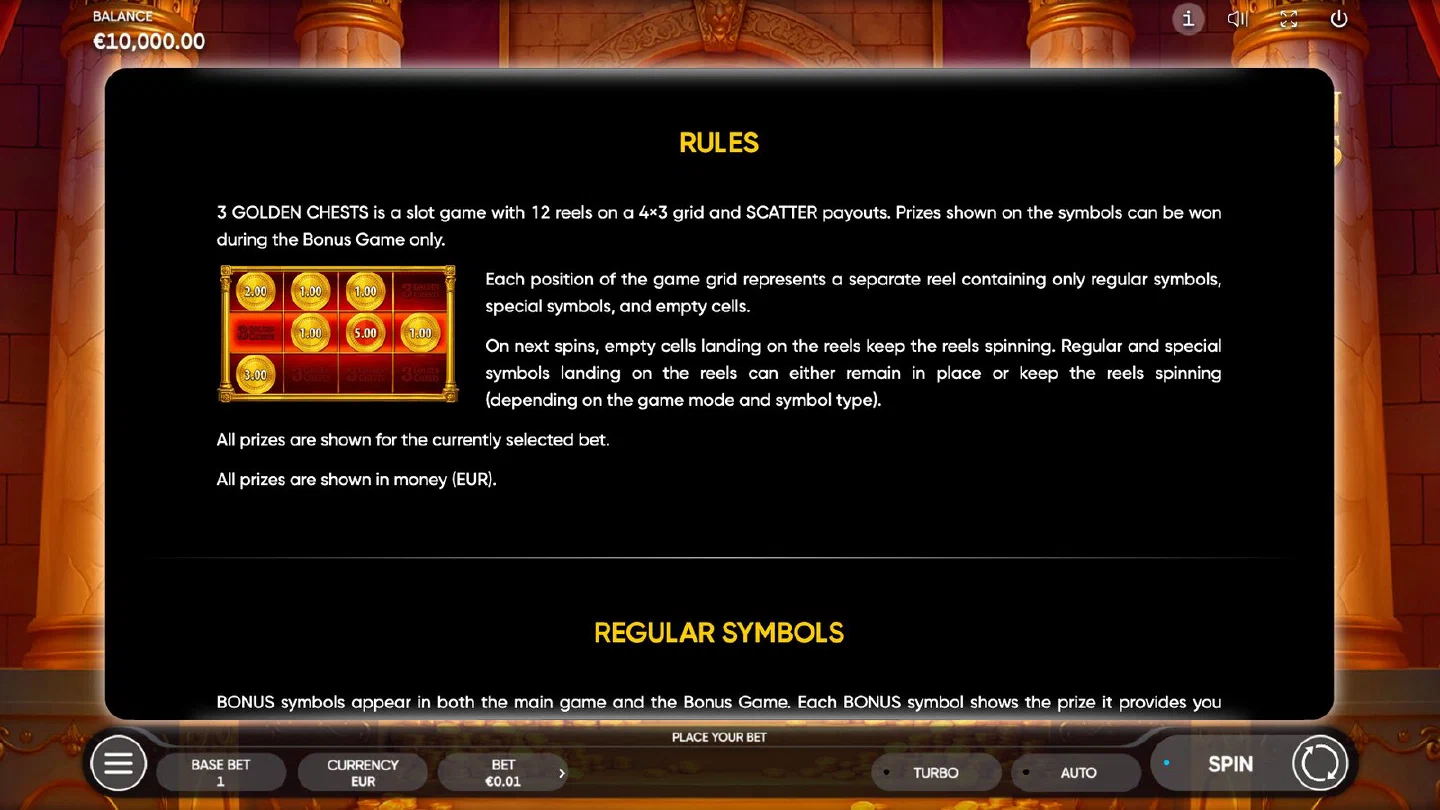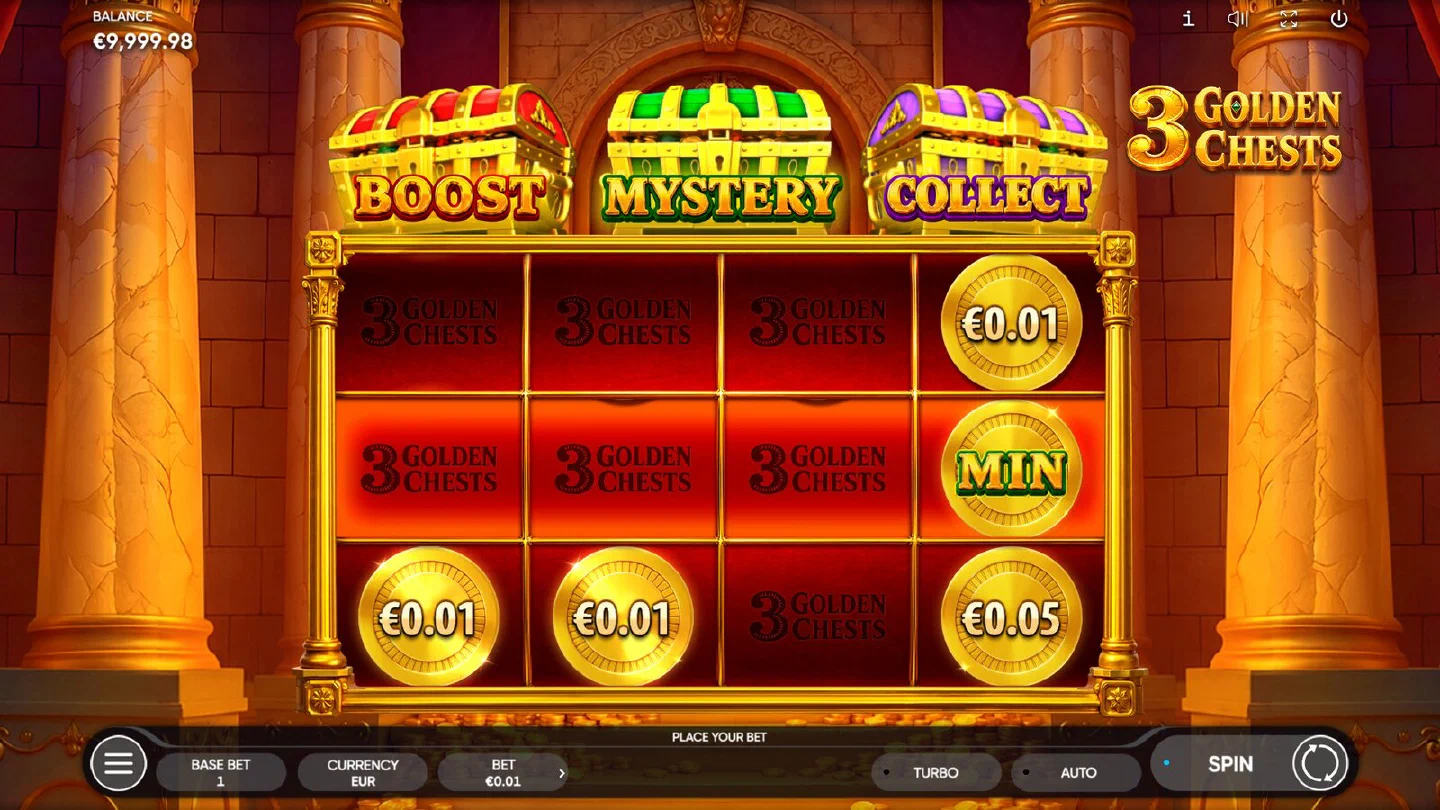
Two vaults, two ways to open them. Mighty Crown: Empire of Gold is the closest relative 3 Golden Chests has in this run: another compact grid in gold, another Hold and Win round with three attempts and a counter that resets on contact. Put them next to each other and the surface similarities hold up, while the underlying design choices turn out to be almost opposite.
| Dimension | 3 Golden Chests | Mighty Crown: Empire of Gold |
|---|---|---|
| Provider | Endorphina | Wazdan |
| Grid | 4 reels x 3 rows, 12 independent reels | 3 reels x 3 rows |
| Win model | scatter pays | 5 fixed lines |
| RTP | 96.04% | 96.13% |
| Volatility | High | Very High in the provider’s material |
| Ceiling | up to 1,400x the total bet | 1,500x the bet |
| Bonus attempts | 3, reset by every new symbol | 3 respins, reset by every new symbol |
The table holds the dimensions both studios publish. Where only one game has a figure, the text below gives it the room a table row could not: the four fixed jackpot tiers on this side, the selectable Volatility Levels and the buy on the other.
Getting into the bonus: earn it or buy it#
Here you earn it; there you can also pay for it. That is the real fork in the road between the two games, and it changes how a budget behaves more than any percentage does.
In 3 Golden Chests the Bonus Game opens when four regular symbols land in the centre row. That is the entire condition, and it means the cost of a bonus is one ordinary spin at whatever stake you have set. The price is the same at the bottom of the rail as at the top, so a small budget buys more attempts at the round rather than fewer.
Mighty Crown: Empire of Gold adds a second door. Its round opens when three BONUS symbols land anywhere on the reels, and it can also be bought outright, priced in five steps at 50x, 100x, 200x, 400x or 600x the bet. Chance Level sits between the two: x2 multiplies the base bet by 2 for at least a 2x higher trigger chance, x5 for at least 6x and x10 for at least 13x, and the paytable stays exactly as it is for the base bet. That is a genuinely different product, because it turns the bonus into a decision you can make with your wallet rather than only an event you wait for, which some players much prefer.
Both approaches have a cost. Buying gives you control and spends your balance in larger units. Earning keeps every spin cheap and puts the timing outside your hands. Worth noting on this side of the table: once the round opens here, the three chests decide independently whether to join, so BOOST, MYSTERY and COLLECT arrive in combinations you cannot influence either. The features page covers what each of them does.
What the entry price does to a budget#
It helps to put the two models next to each other in terms of what a session actually spends. In this game, every spin is simultaneously a bet and a ticket: the trigger condition is on the reels, so a budget divided into more spins is a budget with more chances at the round. Nothing is held back for a purchase, and nothing has to be saved up for.
Where a purchase is on the table, part of the decision is made before the reels move. Paying 50x the bet for entry is a different commitment from paying 600x, and a Chance Level of x2, x5 or x10 sits between the two, raising the base bet instead of buying the round outright. That structure rewards a player who knows what they want and has the balance to act on it, and it can leave a smaller budget with a harder choice.
Neither approach is inherently friendlier, and this comparison is not trying to make one of them sound so. The point is simply that the entry model, more than the decimal place in the RTP, determines how your money moves through an evening. Choose the one that matches how you like to spend it.
Pace and volatility#
High against Very High. Both ratings come from the studios themselves, and both describe games that save their money for the bonus, but the frames they sit in produce very different sessions.
3 Golden Chests spreads twelve independent reels across a 4x3 grid and pays by scatter, so the screen resolves as a whole picture every spin and there is a lot to look at while you wait. Its published hit frequency is 2.78%, about one spin in 36, and since prizes are printed on the symbols and cashed inside the Bonus Game, that figure describes a game of concentrated settles rather than of small regular wins.
The Wazdan title runs a tighter three-reel frame with five fixed lines, which is a classic shape, and its Very High rating suggests it leans even further towards rare, large outcomes. A three-reel grid gives you less to read per spin and a faster read when something lands. It also hands the volatility dial to the player: Low, Standard and High are selectable in play there, with Extreme and Double Extreme sitting behind the buy. Here the rating is fixed at High, and the variation comes from which chests light up instead.
The practical implication is about stake sizing rather than about which game is “better”. Both ask you to pick a stake you can repeat through quiet stretches, and neither rewards raising the bet mid-session. One extra wrinkle on this side: STICKY symbols here hold their position only while the total bet is unchanged, so a mid-session change costs you value directly. The strategy page works through a session plan built on those numbers.
Ceiling and prize tiers#
1,400x with fixed jackpots against 1,500x without them. The headline figures are close: 3 Golden Chests pays up to 1,400x your total bet, with the provider’s own material going as far as 1,500x, while Mighty Crown: Empire of Gold lists 1,500x the bet. On a like-for-like stake that is a difference you would struggle to notice.
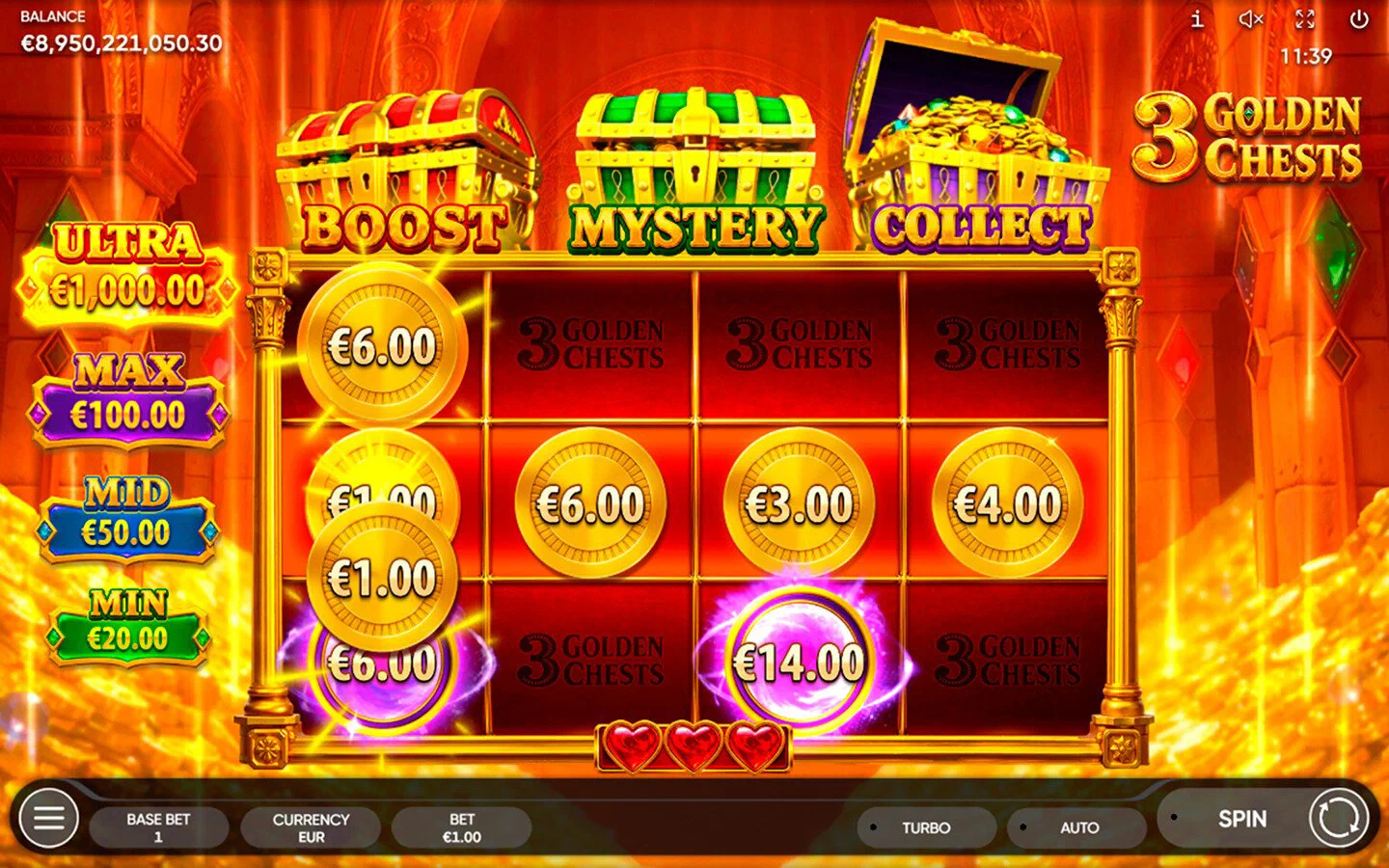
What does differ is the structure underneath. This game carries four fixed jackpot tiers: ULTRA at 1,000x the total bet for a completed board of 12 collected positions, then MAX at 100x, MID at 50x and MIN at 20x. They are fixed multipliers rather than a shared pool, so their value is knowable before you spin and never depends on how recently someone else won.
Priced against a stake, that ladder reads plainly. At a 0.1 total bet, MIN is 2, MID is 5, MAX is 10, ULTRA is 100 and the ceiling is 140. At a 100 total bet the same five figures are 2,000, 5,000, 10,000, 100,000 and 140,000. Nothing else changes between those two rows, because every value in the game is a multiplier of the one number you set.
The tiers also explain how a round reaches the ceiling. ULTRA rewards the full board, and BOOST, MYSTERY and COLLECT keep adding on top of it, which is the mechanical path from 1,000x to the round maximum. Our RTP page prices every step of that ladder.
Where the two rounds feel different#
Both games give three attempts and reset the counter on contact, so on paper their bonus rounds are twins. In practice the grid size changes the experience. Twelve positions on a 4x3 board make a completed board a visible target, and because ULTRA here is tied to collecting all 12, the last stretch of a good round carries real weight. A three-reel frame fills faster and finishes sooner, which suits players who want the round resolved rather than drawn out.
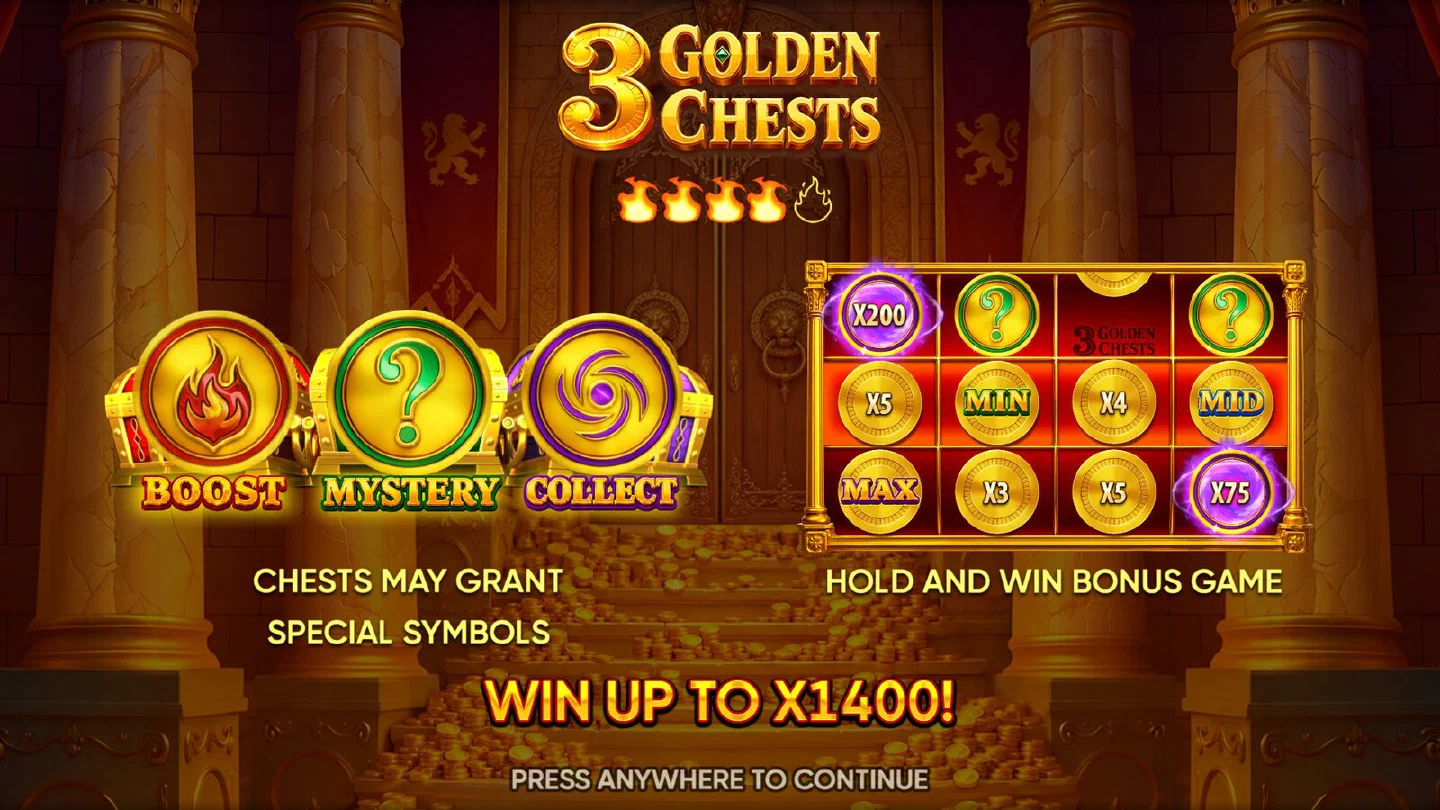
The other difference is what arrives inside the round. In 3 Golden Chests the three chests add three distinct behaviours on top of the money symbols: a multiplier that spreads across the board, a value held face down until the end and a running total that leaves the symbols holding their own prizes. That is a round with several different things happening at once, and it is the main reason two bonuses here rarely feel the same.
Pick by what you actually enjoy doing#
Strip away the percentages and the choice comes down to a preference about process. If you like the feeling of a board filling, a counter you can watch and a round you reached by playing rather than by paying, 3 Golden Chests is the one to open. If you would rather decide when the bonus happens and pay a known price for it, the Wazdan game is built for exactly that, and there is nothing wrong with preferring it.
One last observation for players who like both. Nothing stops you keeping the two for different moods: the Wazdan title for an evening when you want to pay for the round and see it resolve quickly, this one for an evening when you are happy to play towards it and watch the board fill. They cost the same to try, and the ordinary spin is the entry fee here.
For anyone still weighing it up, the cheapest way to settle the question is to spend a few rounds with the demo , which opens a fresh session on every tap and carries every feature of the paid game. The review gives the full verdict on this side, and the slot hub covers the whole game in two screens.