
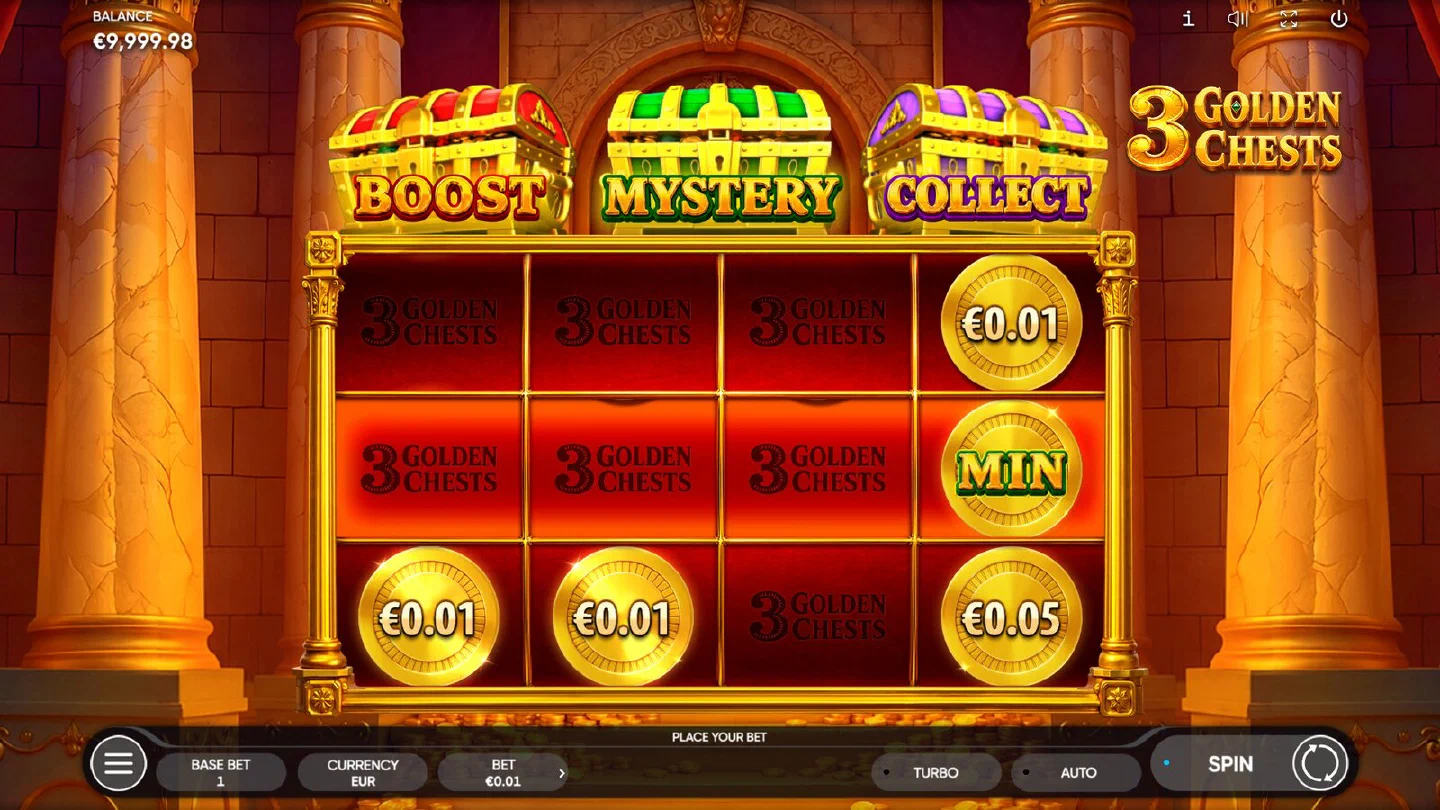
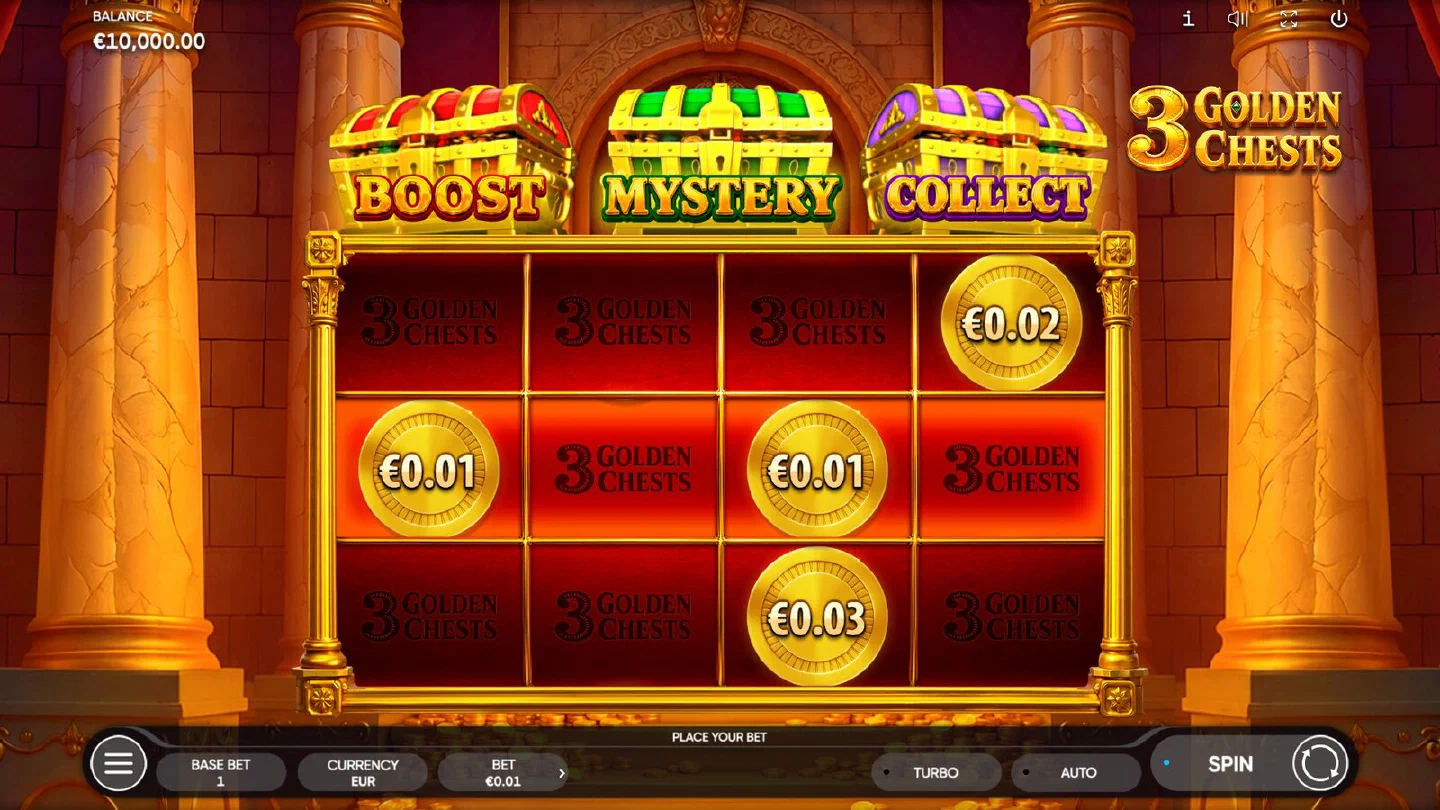
The rules behind the buttons
Why this grid pays without lines, how a bonus round closes, and what the two pace controls actually do.
Twelve reels, one row that decides. That is the shortest honest summary of 3 Golden Chests, and if you read nothing else, read this: the centre row opens the Bonus Game, and the Bonus Game is where the prizes printed on the symbols get paid. Everything below expands those two sentences.
Why you never count paylines here#
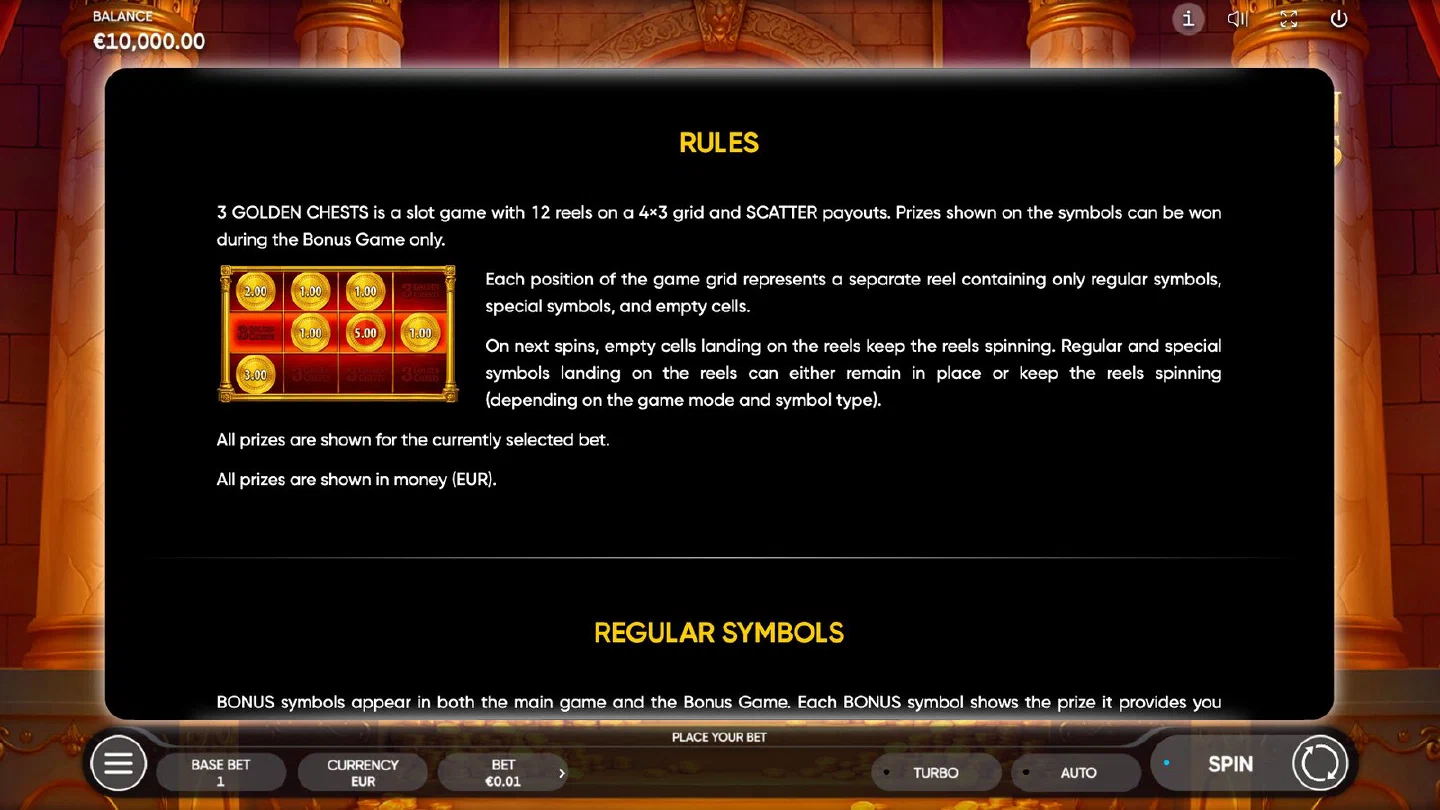
Twelve engines, one screen. The grid is a 4x3, but instead of four reels carrying three symbols each, all twelve positions spin independently. That single design decision removes the most familiar habit in slot play, which is tracking a combination as it builds from the left.
Wins here come from scatter pays. A symbol counts where it lands, so the result is read from the whole grid at once rather than line by line. The practical effect is a faster, calmer session: either the centre row holds its four regular symbols or the next spin starts, and the grid resolves as one picture each time.
The second half of the model is where the money sits. Money symbols carry their prize printed on their own face, calculated for the stake you selected, and those prizes are paid inside the Bonus Game. This is why the base game can look quiet while the grid is quietly accumulating value: what you are watching is a board being loaded, not a sequence of small payouts being missed.
It also means the game carries its own pay table. Move the bet selector and every printed value redraws to match, so you never have to translate between a static table and your actual stake. At a 0.1 total bet a symbol showing 10x is worth 1; at a 100 total bet the same face is worth 1,000.
The bonus round, from trigger to close#
Three attempts that reset to full. Here is the sequence, in the order it happens on screen.
- The trigger. Four regular symbols land in the centre row. That is the whole condition, and it costs one spin at whatever stake you are on.
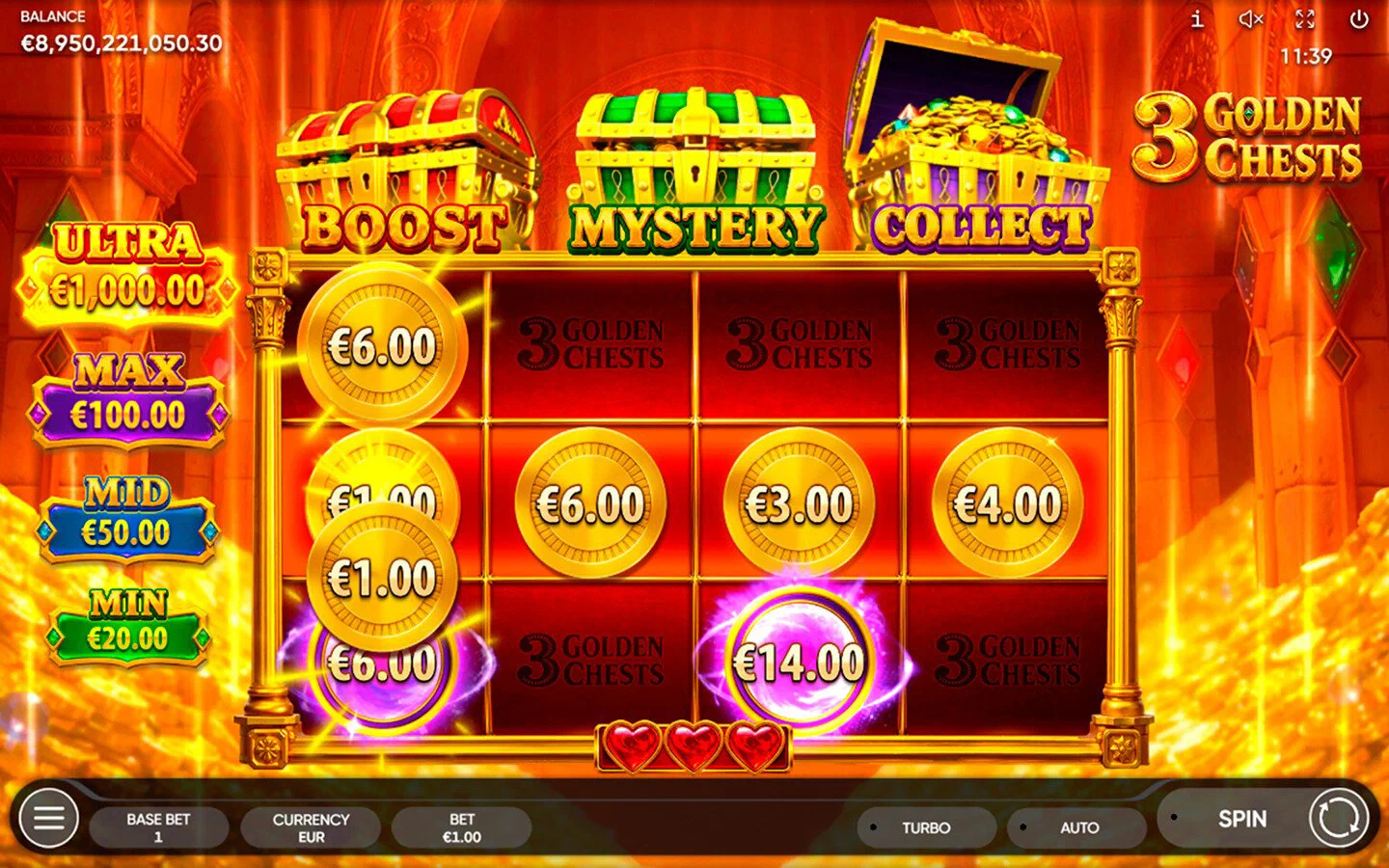
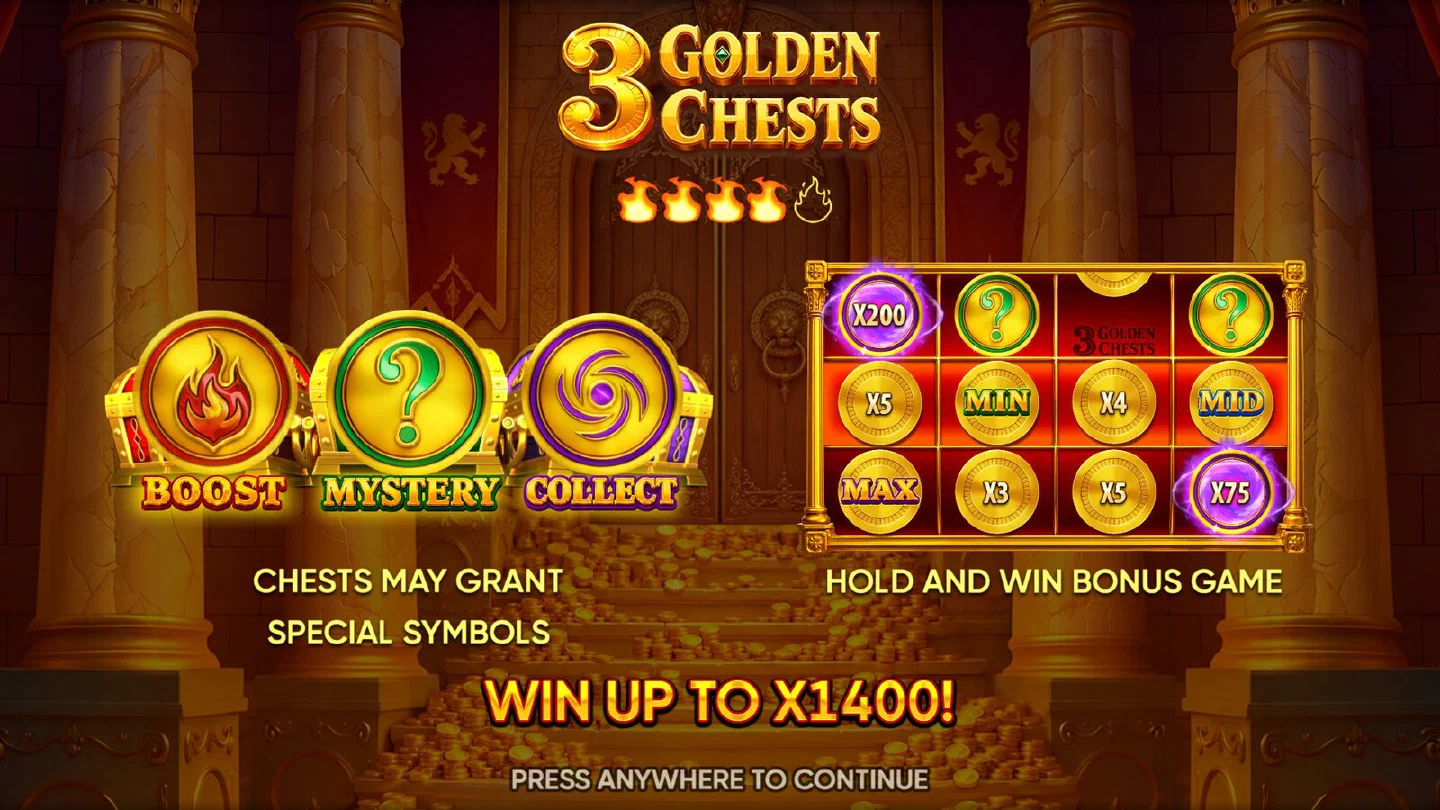
- The chests decide. Each of the three chests above the reels activates at random, independently of the symbols that opened the round. None, one, two or all three may light up, and every one that does adds its own special symbol to the grid: BOOST from the red chest, MYSTERY from the green, COLLECT from the purple.
- The counter starts at three. You have 3 attempts. Every new symbol that lands sets the counter back to the top, so a round that keeps producing symbols keeps extending itself.
- The specials do their work. BOOST adds its own 1x, 2x, 3x, 4x, 5x, 7x or 10x to every BONUS symbol on the grid and then leaves. COLLECT runs a running total of the board and keeps it, without taking anything off the symbols it counted; each COLLECT symbol does that once. MYSTERY stays face down.
- The round closes. It ends when the attempts run out or when all 12 positions are covered. MYSTERY is then revealed, paying MAX at 100x, MID at 50x, MIN at 20x or a regular 7x or 10x, and every prize on the grid is added up in one settle.
Two numbers change inside that round. BONUS symbols are worth 1x to 5x the total bet in the main game and 1x to 10x once the bonus is running, which is the clearest reason the round matters more than the spins around it. And a complete board carries the top tier: ULTRA pays a fixed 1,000x the total bet when all 12 BONUS and special positions are collected.
STICKY symbols belong to the main game and deserve one line of their own here, because their rule is easy to trip over. They carry 5x to 10x the total bet and lock into their position, but only while the total bet stays unchanged. Adjust the bet selector and they release on the next spin, keeping their multiplier. The advice writes itself: pick your stake and leave it alone. The features page covers every symbol in full.
Reading a round as it happens#
What should you actually be looking at while the reels are moving? With this game the answer is short. In the main game, watch the centre row and nothing else. In the bonus, watch the attempt counter, because it tells you exactly how much room is left: three at the top after a new symbol, counting down when a spin adds nothing.
The grid gives you one more useful cue. Since all 12 positions can eventually be covered, you can see a completed board approaching, and that board is the ULTRA condition. A round that has filled nine or ten positions with the counter freshly reset is a round in its best possible shape, and it costs you nothing extra to be there. Everything from that point is mechanical.
What you should not do is read the last few spins as a forecast. Each round is independent of the one before it, the chests activate at random, and the counter resets are a property of the round rather than of your luck so far. The game rewards attention to the current board, not memory of previous ones.
AUTO, TURBO and the pace of your session#
The buttons that set your rhythm both sit on the bottom bar. AUTO runs a series of rounds at the stake you have already chosen, which suits this game well, because the stake is the one setting you want to keep constant. TURBO shortens the spin animation, so the same number of rounds takes less time.
Used together they make the game fast, and that is worth a moment’s thought rather than a warning. A faster pace means more rounds per hour at the same stake, which is exactly the situation in which a pre-set limit does its job. Decide your session length before you switch either control on, and treat the combination as a comfort feature rather than a strategy. The strategy page has a stake-sizing approach that pairs well with AUTO, and the responsible gambling page covers the tools worth setting first.
One more control detail makes the game genuinely mobile-friendly: an unfinished round is kept for 7 days on your account. Close the tab mid-bonus, lose a signal in a tunnel, come back after dinner, and the round is still there. That is what makes a short commute a viable place to start a session.
Picking a stake you can actually keep#
Because every prize in this game is a multiplier of the total bet, the stake is the only number you truly set, and the rail makes that choice wide. Some lobbies open the game at 0.01, others climb to 250, and the panel inside the game shows your exact steps. The rest of the maths follows automatically.
The two pace controls change the number of rounds, never the value of any one of them. AUTO repeats the stake you already set, so it cannot quietly move you up the rail, and TURBO only shortens the animation. Neither touches the 96.04% theoretical return, the High volatility rating or the 2.78% hit frequency: the same three numbers describe a fast session and a slow one, which is why the stake and the round count are the two settings worth deciding in advance.
A worked example makes the decision concrete. At a 0.1 total bet, a 5x money symbol is worth 0.5, a 10x STICKY is worth 1, the MIN tier is 2 and the 1,400x ceiling is 140. Multiply the stake by a thousand, to a 100 total bet, and those same four events are worth 500, 1,000, 2,000 and 140,000. Nothing about the game changes between those two columns, which is the point: choose the column you are comfortable sitting in for a full session, rather than the one that makes the ceiling look impressive.
Two practical notes come out of that. First, because the entry to the bonus is earned on the reels rather than bought, a smaller stake does not buy you a worse path to the round; the trigger condition is identical at every step. Second, since STICKY symbols release when you change the bet, mid-session stake changes cost you more than they gain. Settle on a step, then let the grid work.
The Risk Game: when to use it#
One card against the dealer’s. After a paid round the game offers a gamble: you pick one of four face-down cards, the dealer shows one, and a higher card doubles your payout. You can repeat that up to ten attempts deep, and TAKE WIN ends it whenever you decide.
The rules have two quirks worth knowing before you press anything. The Joker beats every card in the deck and never lands on the dealer’s side, which is a straightforward bonus for you. And an equal card is a draw, so the attempt is simply replayed rather than lost.
The average return of the feature is 84%, which sits below the game’s own 96.04%. That makes it a flourish rather than a path to anything, and the card probabilities are not uniform, so no pattern of past cards tells you about the next one. The RTP page publishes the full spread by dealer card, from 162% against a 2 down to 42% against an ace, which is the most useful thing to have in mind when the screen asks.
A sensible default, if you would rather not think about it mid-session: take the win. The game’s own return is the higher of the two figures on offer, the Bonus Game is where its money lives, and a payout kept is a payout you can still stake on the next round. Use the gamble when you fancy the moment rather than when a round has disappointed you, and set the number of attempts you are willing to make before the cards appear rather than after.
Ready to put all of it into practice? Load the demo for a free rehearsal, or take the slot hub for the two-screen overview and then open a table through the button above.